 From Market Signals to Marketing Decisions
A case study in building an AI briefing that shows which funds moved, why, and how much weight to give the signal.
Overview
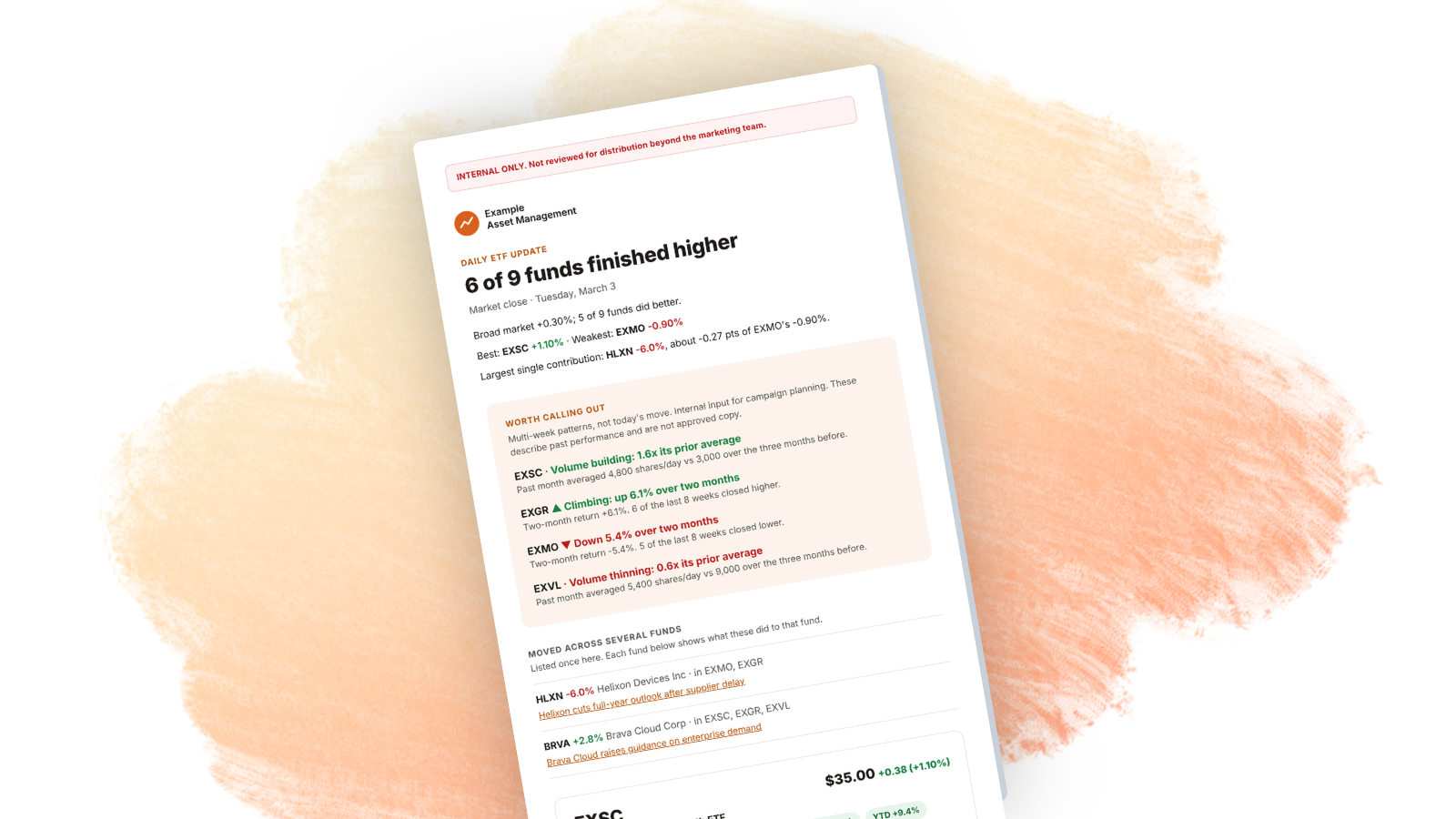
Motley Fool Asset Management (MFAM) manages a lineup of nine ETFs. Marketing them well means knowing what they are doing: which funds moved, what moved them, and whether a move is one day of noise or the start of a pattern. That view did not exist. In July 2026 I built it as an internal daily briefing, produced by an AI agent from public market data, in a template drawn from the same brand system as everything else MFAM ships. In parallel, I built an independent window campaign for every fund: a small, limited-time campaign that can be fired up for any single fund on short notice. When the briefing points somewhere new, marketing can follow it.
The Challenge
Before the briefing, we were in the dark day to day. A fund could climb for two months, or trade at well above its usual volume, and nobody on the marketing side would see it unless they went looking. Building that view by hand each day was never realistic for a lean team, so it simply was not built. The problem was not a slow process. It was a missing one.
Users & Audience
The briefing goes to every member of MFAM's marketing team. I designed it as a discussion point: a shared read on the funds that the team uses to decide where to put its effort next, and when to pivot. It reads in under a minute at the top and in depth below. It is not investor-facing, and the page says so.
Role & Responsibilities
I built every piece. I defined the questions the briefing should answer, designed and coded the email template, set the thresholds for what counts as a signal, and built the AI agent that pulls the data, runs the comparisons, and drafts the copy. I also built the other half of the system: an independent window campaign for each of the nine funds, with its ads, emails, and landing pages made ahead of need. I am the human in the loop on both: I set the rules, and I read the output.
Scope & Constraints
The briefing covers nine funds and their holdings, every market day. Two constraints shaped it. First, it runs on public market data and last-reported holdings, so some inputs lag and some ratios are noisy, and the briefing has to say so rather than hide it. Second, it stays internal. Sending fund performance commentary beyond the company would need compliance, legal, and regulatory review, and that is not a reasonable ask of those teams for a daily product. Staying internal is a design decision, not a shortfall.
The Process
- Pulling the day's data: At market close, the agent collects prices and volume for each fund and for the stocks each fund holds.
- Putting the day in context: The headline answers the first question in one line: how many of the nine funds finished higher. Below it, the briefing compares the funds with the broad market, names the best and weakest fund, and calls out the single holding that contributed most to any fund's move.
- Reading past the day: Each fund shows its five-day, twenty-day, and year-to-date moves, a two-month trend with how many recent weeks closed higher or lower, and whether it is trading near its all-time high or low. One day is rarely the story.
- Reading volume: The agent compares the day's volume with the twenty-day average, and the past month with the three months before it, then tags each fund as building or thinning. This is the read on whether interest in a fund is growing, apart from what the market did to its price. Where a fund trades thinly enough that the ratio is unreliable, the briefing says the ratio is noisy.
- Explaining each move: For every fund, the agent lists the holdings that moved most, how much of the fund each one is, and roughly how much of the fund's move each one accounts for. A large drop in a small holding and a small drop in a large holding get weighed correctly. Stocks held by several funds are listed once, with the funds they sit in.
- Attaching headlines: For the biggest movers, the agent attaches a news headline, filtered to stories that name the company. These are matched by same-day timing, and the briefing labels them as that, not as verified causes.
- Flagging patterns for campaign planning: A "Worth calling out" block at the top collects the multi-week patterns: funds on a sustained climb or decline, volume building or thinning. It is labeled as input for planning and as not approved copy.
- Keeping a person in the loop: A banner on every send states that the email has not been reviewed for distribution beyond the team. I set the thresholds and read the output.
- Making the pivot cheap: A signal is only useful if the team can act on it. Each fund has its own independent window campaign, with ads, emails, and landing pages built from the compliance-cleared component library. Shifting focus to a different fund for a few weeks is a decision, not a production cycle.
Outcomes & Lessons Learned
The briefing has already changed a plan. We were setting up a campaign around a momentum fund that had been strong through the first half of the year. The briefing showed it slowing, week over week, while a small-cap growth fund was building significantly. Because that fund's window campaign already existed, we moved to it instead of launching behind a fading story. Before July 2026 there was no daily read on the funds at all, so I have not attached a time-saved figure. The honest baseline is zero: this work was not being done.
The biggest lesson: an AI system earns trust by labeling its own limits. The briefing says when a volume ratio is noisy, when holdings weights lag, when a headline is a timing match and not a cause, and when a number is a ranking aid and not performance attribution. Those labels took as much design work as the layout, and they are the reason the briefing can be read quickly without being over-read.
The second lesson is about where to stop. The same system could draft outward-facing commentary. It does not, because the review that would require is not available at daily speed. Knowing which outputs stay internal is part of governing AI in a regulated business.
Disclaimer: Confidential details have been omitted or modified to respect the privacy of the organizations involved. Visuals use fictional funds and figures.